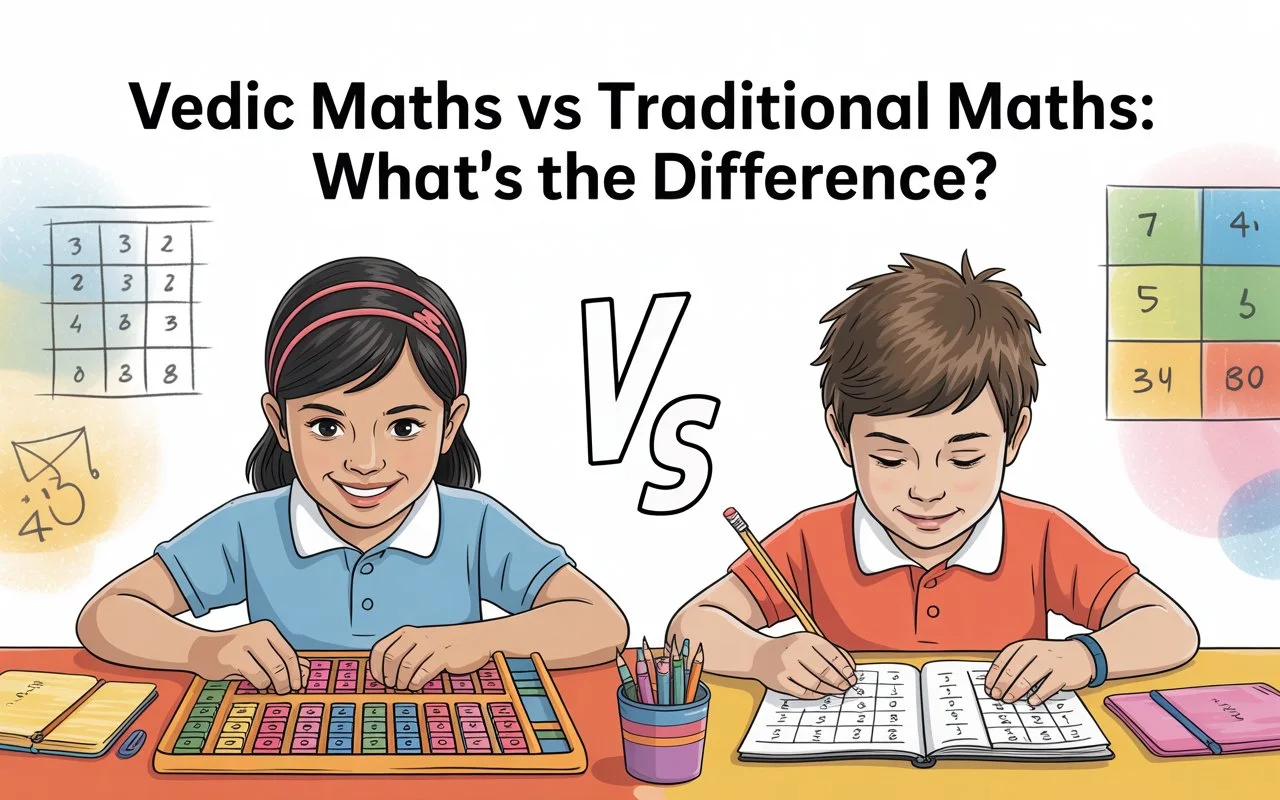
Vedic Maths vs Traditional Maths: What’s the Difference?
Updated on June 10, 2025, 4:42 p.m.
Key Differences Between Vedic Maths and Traditional Math for Learners
Choosing between Vedic Mathsand thetraditional method can be confusing, especially when both have unique benefits. While Vedic Maths focuses on speed and mental tricks, traditional maths emphasizes deep understanding and step-by-step problem-solving.
This blog explains both methods in a clear and simple way, helping students understand the key differences and decide which approach fits their learning style best.
What is Vedic Maths?
Vedic Maths comes from ancient Indian texts called the Vedas.
It uses 16 sutras (formulas) to solve math problems quickly and mentally.
It’s all about speed, mental math, and clever tricks.
Popular in competitive exams, Olympiads, and fast-paced learning environments.
What is Traditional Maths?
Traditional Maths is what we learn in school curriculum.
It includes clear step-by-step written procedures for solving problems.
Focuses on understanding concepts deeply — like addition, subtraction, algebra, geometry, etc.
Used globally in classroom teaching and academic exams.
Key Differences Between Vedic and Traditional Maths
Feature
Vedic Maths
Traditional Maths
Style
Mental math, shortcuts
Step-by-step, written
Speed
Very fast
Slower but thorough
Learning Curve
Quick to learn tricks
Takes more time to master concepts
Focus
Fast calculation
Concept clarity and logic
Best Used For
Competitive exams, fast solving
Board exams, higher education
Advantages of Vedic Maths
Helps children calculate faster than usual.
Builds confidence and concentration.
Reduces exam stress by providing quicker methods.
Makes learning fun and engaging, especially for slow learners.
To know more about benefits of vedic maths, checkout the blog given below,
Lays the foundation for higher-level topics like algebra, calculus, and statistics.
Ideal for school and board exams.
Encourages logical and analytical thinking.
Vedic Maths Techniques: Simple Examples
Multiplication Trick (Urdhva Tiryak Sutra): Multiply 98 × 97 using a shortcut instead of long steps.
Addition Trick: Add numbers like 999 + 456 by rounding up and adjusting quickly.
Division Shortcut: Divide numbers like 132 ÷ 6 using pattern-based tricks.
These tricks are not just fun but save a lot of time during exams.
Traditional Method Examples
Multiplication: Using the standard long multiplication method taught in schools.
Division: Long division method with step-by-step clarity.
Fractions and Decimals: Handled using written steps and logical explanation.
Which One is Easier to Learn?
Vedic Maths is easier for children who like patterns and shortcuts.
Traditional Maths is better for those who prefer learning concepts slowly and thoroughly.
Younger children often enjoy Vedic tricks, while older students rely more on traditional math.
Where Vedic Maths Works Best
Perfect for competitive exams (like Olympiads, entrance tests).
Helpful for students who want to improve their calculation speed.
Useful in mental math competitions or fast-paced problem solving.
Where Traditional Maths is Necessary
Essential for school exams, board results, and academic understanding.
Crucial for higher-level topics like algebra, geometry, trigonometry, and calculus.
Provides a step-by-step roadmap to solve any type of problem.
Can Students Use Both Methods?
Yes! In fact, many students use Vedic Maths for speed and Traditional Maths for deep understanding.
Example:
Use Vedic tricks to calculate faster during practice or mock tests.
Use traditional steps to understand how and why a problem works.
It’s a perfect combo!
100% Free · No Commitment
Know Your Child's Academic Learning Level
Unlock your child's true potential with a free one-on-one academic assessment. Identify strengths, improve weak areas, and build confidence with expert guidance.
Start your maths journey with Interval Learning where learning is fun, personalised, and stress-free!
Frequently Asked Questions
Not better — just different. Vedic Maths is great for speed; traditional maths is important for depth.
It can help with speed but should be used along with traditional methods for accuracy and structure.
Kids as young as 8 years can start with basic Vedic Maths tricks.
Board exams expect traditional steps, so Vedic tricks can help with practice but not for final answers.
Yes! We offer personalised support for both Vedic Maths and Traditional Maths.

INTERVAL LEARNING
Interval Learning is an online platform that offers one-on-one tutoring in both academic and non-academic subjects. We match students with skilled tutors to create a personalized learning experience across a range of topics. Our resources cover study tips, education trends, and personal development advice to help students, parents, and educators reach their goals. At Interval Learning, we focus on making education accessible, engaging, and suited to each learner’s needs.
Unlock your child's true potential with a free one-on-one academic assessment. Identify strengths, improve weak areas, and build confidence with expert guidance.
The Best Online Tutoring Platform That Meets All Your Child’s Needs
Interval is your child’s dedicated academic partner, offering personalized learning experiences
crafted just for them. With passionate tutors and a nurturing environment, we ensure that every
lesson aligns with your child’s unique needs, empowering them to thrive and excel in their studies
while building confidence.