
One-on-one tuition vs group tuition: an honest comparison for parents
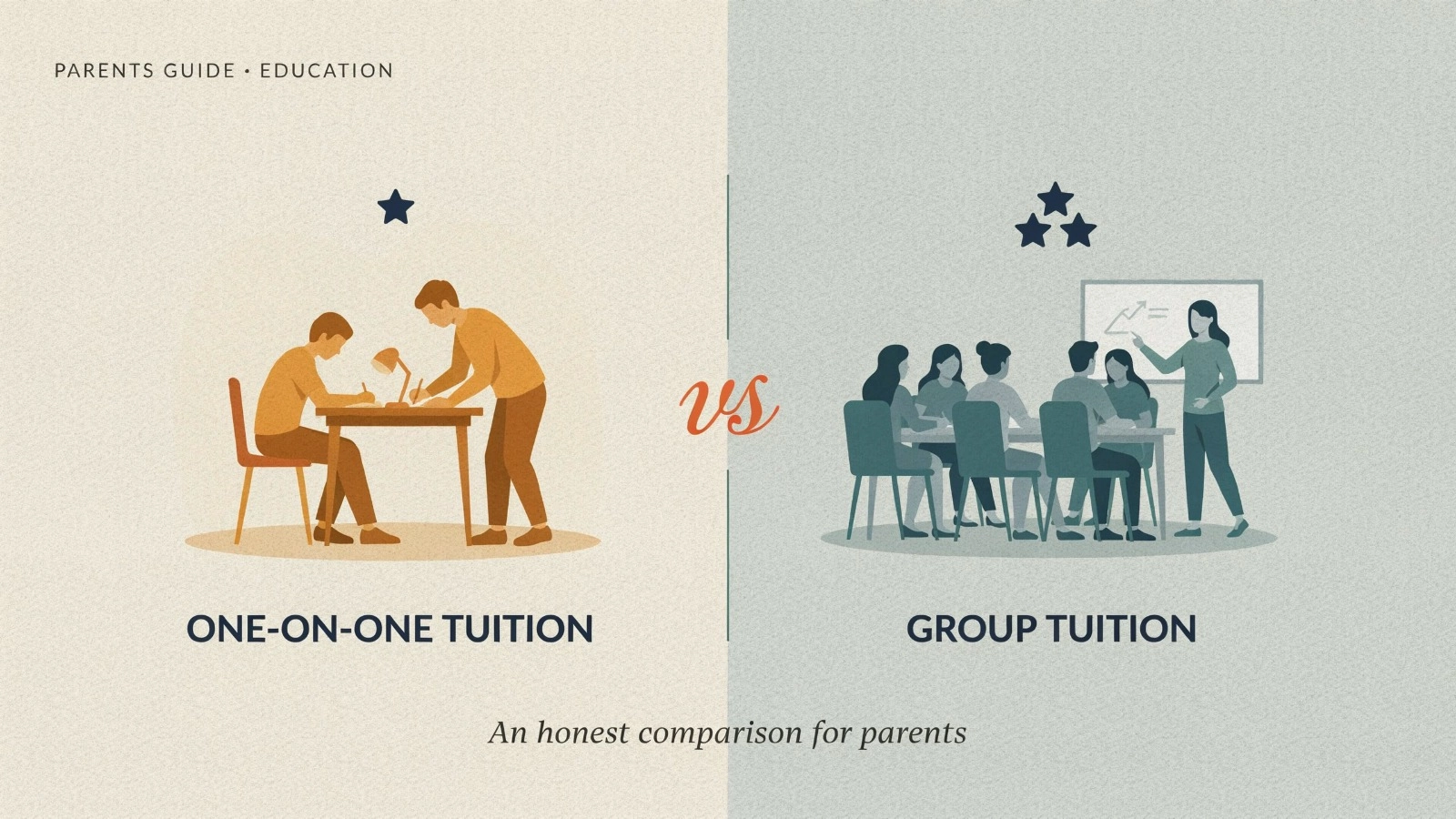



When your child’s grades drop, the big question is always: one-on-one tuition vs group tuition? Most websites just say "private tutors give more attention" and leave it at that. But it’s rarely that simple.
Picking the wrong setup wastes your money and, worse, your child's time. Let's skip the marketing talk. Here is an honest, realistic look at both options so you can figure out what will actually help your child improve.
One-on-one tuition means your child and one teacher alone in the session.
The technical term for this is a 1:1 teacher-student ratio. Everything that happens in that hour is built around your child only. The teacher sees how your child thinks, what they understand, where they get stuck and adjusts every single minute of the class accordingly.
This is also called:
Group tuition means one teacher and multiple students, anywhere from 5 to 30+ students, learning together.
The teacher follows the same lesson plan for everyone. The pace, the examples, the explanations all designed for the average student in the batch.
This is also called:
Aspect | One-on-One Tuition | Group Tuition |
| Attention | Full, personalized attention from the tutor | Attention is divided among multiple students |
| Pace of Learning | Customized to the student's speed can slow down or accelerate as needed | Fixed pace set for the average of the group |
| Doubt Resolution | Instant, in-depth clarification of doubts | Doubts may be limited by time or hesitation to ask in front of peers |
| Curriculum Flexibility | Fully tailored to the student's strengths, weaknesses, and goals | Standardized curriculum for the whole batch |
| Cost | Higher, since resources are dedicated to a single student | More affordable, as costs are shared among students |
| Peer Learning | Limited exposure to how others approach problems | Encourages peer discussion, healthy competition, and shared problem-solving |
| Comfort & Confidentiality | Ideal for introverted students or those needing a stress-free environment | Can be intimidating for shy students but builds social/exam-hall confidence |
| Scheduling | Flexible timings based on students' availability | Fixed schedule aligned with the group's convenience |
| Progress Tracking | Highly detailed, individual performance tracking | General tracking, often batch-wide assessments |
Tuition for weak students is one of the most common reasons parents search for private tutors. If your child is behind the class level in one or more subjects, group coaching will almost never solve it.
A group teacher moves with the batch. A private tutor stops, goes back to where the gap is, rebuilds the concept, and only moves forward when your child is ready.
For students preparing for high-stakes board exams, personalised one-on-one tuition delivers significantly better student attainment than group classes.
The reason is simple: board exam success depends on individual strengths and weaknesses assessment, targeted preparation, and chapter-wise mock testing none of which a group class can do for each student individually.
Explore Interval Learning's one-on-one Tuition Classes
If your child hesitates to ask questions in front of others, group tuition will not solve the problem it will deepen it. One-on-one tuition builds academic confidence session by session because your child never has to perform in front of peers.
If your child is good overall but consistently loses marks in one subject, say, Physics or Maths a private tutor can give that subject the direct feedback, concept drilling, and doubt clearing it needs.
Marks improvement in a specific weak subject is one of the fastest and most visible outcomes of one-on-one tuition.
NEET and JEE preparation requires deep concept clarity and strong problem-solving ability. Batch coaching gives syllabus coverage. But mentor-driven learning in one-on-one sessions is what builds the depth of understanding that entrance exams require.
Explore Interval Learning's Daksha program for NEET and JEE
Being honest means being fair to both options. Group tuition works in these situations:
Watch for these signs:
Let us be honest about the tuition cost comparison.
The gap looks large. But here is what parents often do not calculate:
If your child spends 5 months in group coaching without improvement, then switches to private tuition for 3 months before the exam, you have paid for 8 months of tuition instead of 3 or 4.
Private coaching vs group coaching is not just a cost comparison. It is an outcome comparison. One-on-one usually delivers faster results, which often means fewer months of tuition needed overall.
Class | Best Format | Why |
| LKG to Class 2 | One-on-One always | Young children need constant individual engagement |
| Class 3 to 5 | One-on-One preferred | Foundation building needs gap detection |
| Class 6 to 8 | One-on-One strongly recommended | Learning gaps here directly affect Class 10 results |
| Class 9 and 10 (SSLC) | One-on-One for board prep | Marks improvement and exam strategy are individual |
| Class 11 and 12 | One-on-One for Science; small group for Commerce revision | Science needs concept clarity and mentor-driven learning |
At the end of the day, there is no one-size-fits-all answer. Group tuition can be perfectly fine for a quick exam revision or for students who already feel confident and just want to study alongside peers.
But if your child is genuinely falling behind, losing confidence, or trying to clear high-stakes hurdles like Class 10/12 Board exams or NEET/JEE, one-on-one tuition is the investment that actually moves the needle. It stops treating your child like an average of a massive classroom and starts focusing entirely on how they learn best.
At Interval Learning, we support your child’s goals with both personalized one-on-one tuition and focused group classes. Our group tuition option, called "Super 15," limits batches to just 15 students so nobody gets left behind in a crowd. Whether you choose individual attention or group energy, we help clear doubts and unlock the grades they are truly capable of.