Online Tuition for IGCSE Students: How to Find the Right Tutor



IGCSE stands for International General Certificate of Secondary Education a globally recognised school qualification from Cambridge International, followed by many schools in India and abroad. Unlike CBSE or State Board exams, IGCSE doesn't just test memory. It tests how well a child can think, apply concepts to new situations, and explain their reasoning, not just write the "right" answer.
That's why finding the right online tutor for IGCSE students is different from finding a CBSE or State Board tutor. A tutor good at CBSE may not understand the Cambridge IGCSE syllabus or how its papers are marked. This guide covers everything you need to know about online tuition for IGCSE students in simple, easy words.
IGCSE stands for International General Certificate of Secondary Education.
This is a very popular international school program for 14 to 16-year-olds. It is basically the same as Class 9 and Class 10 in Indian schools. Two main exam boards offer it:
Both boards offer exams in over 70 subjects, including Mathematics, Physics, Chemistry, Biology, English Language, English Literature, Economics, History, Geography, Computer Science, and many more.
Students studying IGCSE in India are most commonly enrolled in international schools in cities like Mumbai, Bengaluru, Chennai, Hyderabad, Delhi, Kochi or in Gulf countries like the UAE, Qatar, Oman, and Saudi Arabia, where Indian expat families follow British-curriculum schools.
Here is what makes the IGCSE genuinely different and why this matters when choosing a tutor:
IGCSE students in India and the Gulf face a very specific challenge.
The IGCSE board is followed mainly in international schools in larger cities and Gulf countries. Quality IGCSE tutors who know the Cambridge or Edexcel syllabus specifically are not easy to find nearby, especially in smaller cities or when your child is studying in Dubai, Qatar, or Oman and needs support from home.
Online tuition solves this directly:
At Interval Learning, we have worked with hundreds of IGCSE students across India and the Gulf, covering Cambridge and Edexcel subjects from Maths to Physics to English. Our tutors are specifically trained in the IGCSE exam format, question styles, and marking schemes. That is a very different thing from being good at the subject in general.
Here are the 8 most important things to look for and the questions to ask before you book:
Do they know the exact IGCSE exam?
Don't hire a general tutor who says they can teach "any type of math." IGCSE has specific rules. Ask them directly if they know your child's exam board (like Cambridge or Edexcel) and if they understand how the test is graded.
Do they practice with old exam papers?
Practicing real past papers is the best way to get ready for the test. A great tutor will use exam papers from the last 5 years to show your child exactly how to answer questions to get full marks.
Do they know the different study levels?
Many IGCSE subjects have two levels: Core (standard) and Extended (advanced). Make sure the tutor knows exactly which level your child is taking so they don't teach the wrong material.
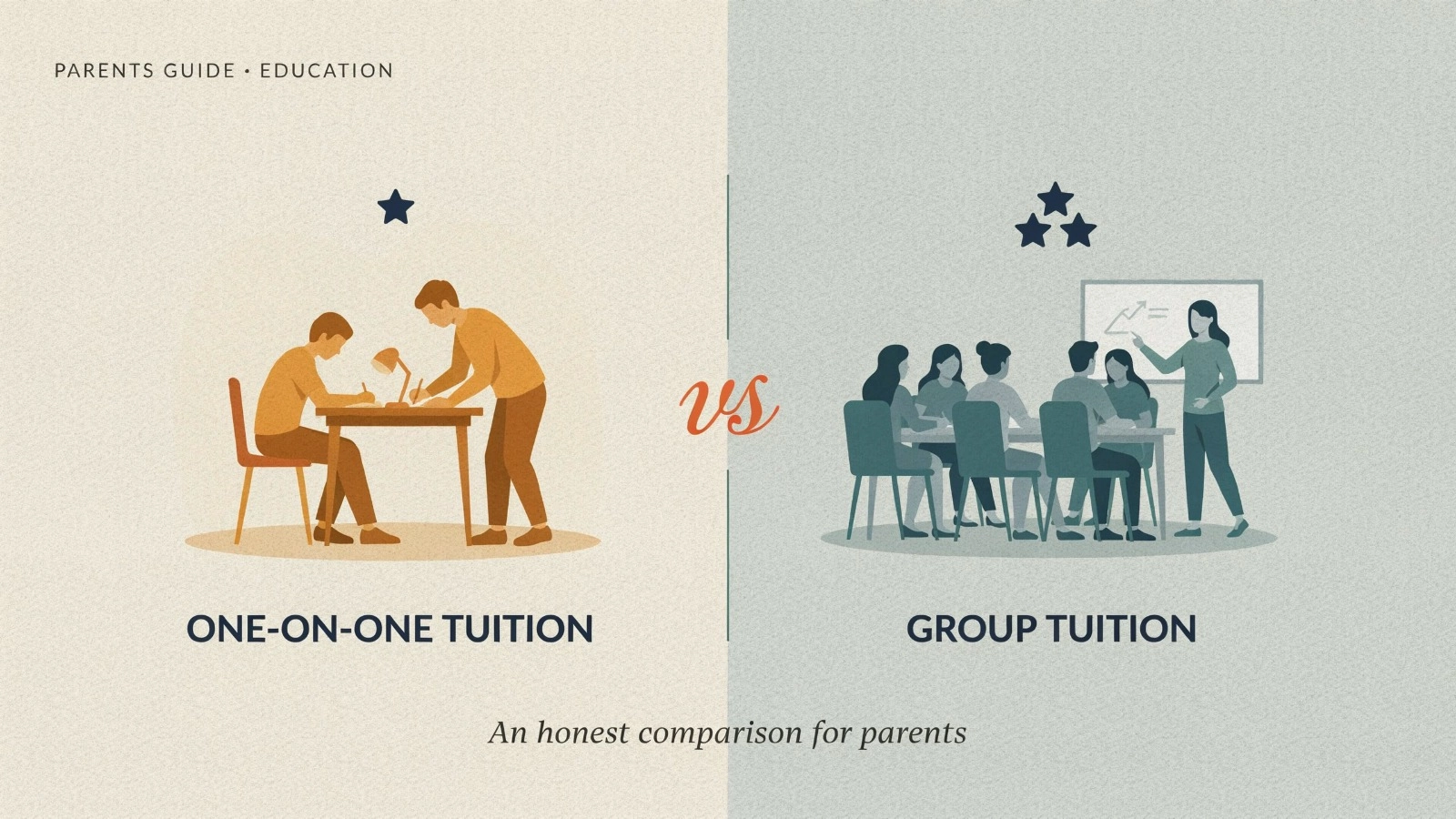
Is the class one-on-one?
Group classes move at an average speed for everyone. In a one-on-one class, the tutor spends the whole hour focusing only on what your child finds difficult. This personal attention makes a massive difference in final grades.
Can you get a free trial class?
Never pay money before trying a class out. Use a free demo session to check two things:
Do they teach the specific subjects your child needs?
Students usually take 5 to 10 subjects. Make sure the tutor or platform can help with the exact areas your child struggles with the most, whether that is Math, tricky Science topics, or English essay writing.
Do they send you regular updates?
You shouldn't have to wait for a school report card to know how your child is doing. Look for a tutor who sends a quick update (like a text or short note) after every single class to tell you what they worked on.
Are the classes recorded?
Some topics are hard to understand the first time around. If the video lessons are recorded, your child can rewatch the tricky parts later, double-check their notes, and study easily right before exam day.
Different IGCSE subjects have very different challenges. Here's what to focus on for each:
The most common subject students seek tuition for. IGCSE Maths has two papers Paper 1 and Paper 3 for Core, Paper 2 and Paper 4 for Extended.
Extended Maths includes topics like functions, vectors, transformation geometry, and probability which are significantly harder than what CBSE Class 10 covers. Students who transfer from a CBSE school to an IGCSE school in Class 9 often find this gap the most shocking.
What a good IGCSE Maths tutor does:
Looking for Maths support? Explore Interval Learning's Maths Tuition
IGCSE Physics is concept-heavy and application-based. Students cannot score well by memorising definitions alone.
What a good IGCSE Physics tutor does:
Explore Physics Tuition at Interval Learning
Many students find IGCSE Chemistry manageable up to Chapter 5 or 6, and then suddenly hit a wall when organic chemistry and electrolysis arrive.
The key skill in IGCSE Chemistry is being able to explain chemical reactions in terms of particles, bonds, and energy, not just state the reaction.
What a good IGCSE Chemistry tutor does:
Explore Chemistry Tuition at Interval Learning
IGCSE Biology is one of the most manageable IGCSE sciences if studied correctly. The syllabus is clear, the topics are logical, and a student who understands the content can score very well.
The challenge is applying biological concepts to new scenarios in the exam. Questions often describe a new experiment or biological context the student has never seen and ask them to explain what would happen and why.
What a good IGCSE Biology tutor does:
English Language is one of the most misunderstood IGCSE subjects. Many parents assume it is straightforward because their child speaks English fluently.
But IGCSE English Language is about writing technique not speaking ability. The directed writing task, the summary task, and the composition require specific skills: selecting relevant information, writing with purpose, structuring ideas clearly, and varying sentence structure.
Many fluent English speakers lose significant marks because they don't know how to write in the format IGCSE rewards.
What a good IGCSE English tutor does:
Explore English Tuition at Interval Learning
Many Kerala families living in the Gulf have children in British-curriculum international schools following the Cambridge IGCSE.
These parents face a specific challenge: they want quality IGCSE tutors who understand Indian and Malayali learning styles, can explain in Malayalam or Hindi when needed, and are available during Gulf evening hours.
This is exactly the kind of support Interval Learning provides. Our tutors are based in Kerala and trained in IGCSE, working with NRI students across UAE, Qatar, Oman, and Saudi Arabia at timings that suit Gulf schedules.
Your child doesn't have to compromise between quality and cultural familiarity. They can have both.
Mistake 1: Choosing a CBSE-trained tutor for an IGCSE student
The syllabi, question styles, and marking schemes are completely different. A tutor who is not familiar with IGCSE specifically will prepare your child for the wrong kind of exam.
Mistake 2: Going for the cheapest option
IGCSE is a globally recognised qualification. Your child's grade will appear on university applications. The cost of poor preparation is far higher than the money saved on a cheaper tutor.
Mistake 3: Starting tuition only when exams are close
IGCSE content is cumulative; topics build on each other. Physics in Chapter 8 assumes understanding from Chapter 3. Starting support early (at the beginning of the academic year) is far more effective than emergency preparation in the final 6 weeks.
Mistake 4: Picking a platform that covers too many boards without depth.
Some platforms claim to cover IGCSE, CBSE, IB, A-Level, and 10 other curricula. No single tutor can be an expert in all of them. Look for tutors who are genuinely specialised in IGCSE, especially Cambridge or Edexcel specifically.
Mistake 5: Not attending the demo class with your child
The demo class tells you everything. How does the tutor explain? Does your child ask questions or go quiet? Is the teaching IGCSE-specific or generic? Sit in, at least for the first 10 minutes.
Before you enrol, confirm all of these:
At Interval Learning, we understand that IGCSE is not just another board. It is a globally respected qualification that requires a specific kind of preparation and a specific kind of teacher.
Here is how we support IGCSE students:
Interval has been working with students from LKG to Class 12 across CBSE, ICSE, Kerala State Board, and IGCSE for over 10 years. More than 50,000 students have learned with us. IGCSE is one of the boards we take most seriously, because the stakes for your child's global future are highest here.
The best online tuition for IGCSE students is one that is specifically trained in either Cambridge or Edexcel, whichever your child's school follows and offers one-on-one live sessions with past paper practice built in. Interval Learning covers IGCSE subjects with dedicated tutors who know the exact syllabus and marking schemes.
Yes, especially when it is one-on-one and IGCSE-specific. Online tuition allows students to access tutors who truly specialise in Cambridge or Edexcel, regardless of where they live. For NRI families in the Gulf, it removes the geographical barrier entirely.
The most commonly sought IGCSE tuition subjects are Maths (0580), Physics (0625), Chemistry (0620), Biology (0610), and English Language (0500). Of these, Maths and Physics tend to have the highest demand because of how different the question style is from what students are used to in Indian school systems.
Ideally at the start of the academic year when your child begins the IGCSE curriculum. Starting early allows the tutor to build a strong foundation before the complexity increases. If your child is already in the middle of the IGCSE years and struggling, starting immediately is still far better than waiting.
Both are internationally recognised qualifications. Cambridge IGCSE is offered by Cambridge Assessment International Education (CAIE) and is the more widely followed in Indian and Gulf schools. Edexcel is offered by Pearson and follows a slightly different syllabus and marking approach. A tutor should know which board your child's school follows and prepare accordingly.
Yes. Interval Learning works with students in UAE, Qatar, Oman, and Saudi Arabia. Our tutors are available in the evenings according to Gulf time zones, and sessions are conducted online from home. This is one of the most common situations our team handles.
Cambridge IGCSE uses a grade scale from A* (highest) to G. Most universities and schools require a minimum of Grade C for a subject to count. Edexcel IGCSE uses a 9 to 1 scale, where 9 is the highest. Grade boundaries the marks needed for each grade shift slightly between the May/June and October/November exam series.
Yes. All new students get a free demo class with no payment required. This gives your child a chance to experience the teaching style and ask questions before you decide to enrol.